Mobile Apps
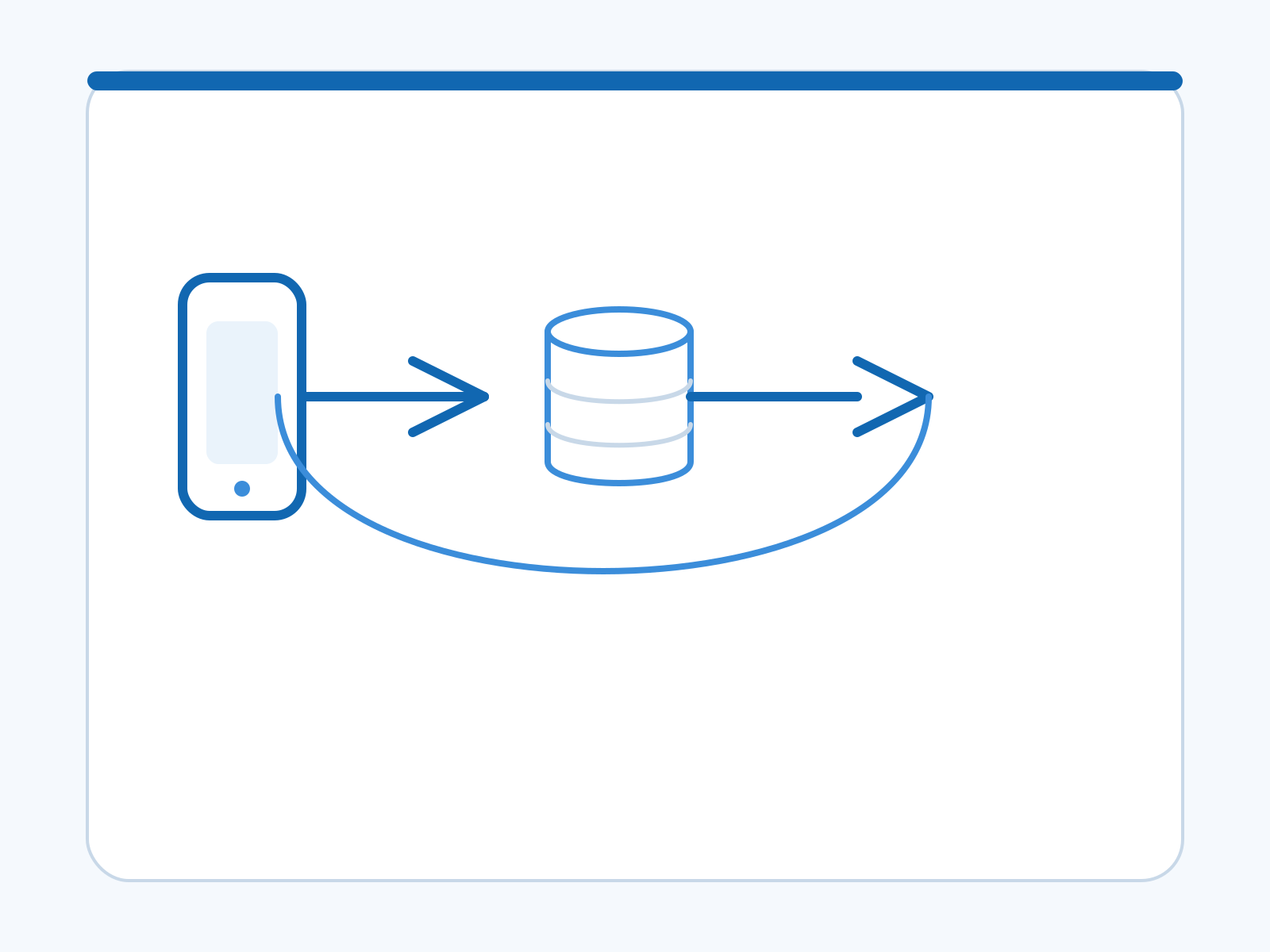
Mobile applications can keep local data and synchronise later with remote services. The UI, local store and backend can therefore temporarily contain different values, and a reconstruction must place local writes, requests, responses and synchronisation events on a common timeline.
Short answer
Mobile applications can keep local data and synchronise later with remote services. The UI, local store and backend can therefore temporarily contain different values, and a reconstruction must place local writes, requests, responses and synchronisation events on a common timeline.
A technical conclusion should distinguish the directly observed state from inferred execution, provenance or causation and remain limited to the documented versions, environment and evidence available for the examination.
1. Define the path between app and backend
Identify which local store, networking component, API and backend state are relevant to the data item under examination. A value displayed in the UI is not automatically proof that the same value has been persisted remotely.
Likewise, the presence of client networking code or a documented endpoint establishes a possible path, not that a particular request was sent in the disputed interaction.
The examination should distinguish direct observation from reconstruction. A configuration entry, API declaration, registered callback or stored value establishes only the state that was actually preserved; it does not by itself prove execution, causation or historical persistence. Where a relevant historical state cannot be recovered, the limitation should remain explicit rather than being filled by assumption.
2. Treat offline mode as a separate operating state
Offline-first designs can read and write local data while deferring remote synchronisation. Document whether the device had network connectivity and whether the application was expected to operate locally.
Loss of connectivity is not automatically an application error; the expected behaviour depends on the implemented offline strategy and the specific operation being tested.
The examination should distinguish direct observation from reconstruction. A configuration entry, API declaration, registered callback or stored value establishes only the state that was actually preserved; it does not by itself prove execution, causation or historical persistence. Where a relevant historical state cannot be recovered, the limitation should remain explicit rather than being filled by assumption.
3. Reconstruct synchronisation events over time
Place local changes, queued operations, network attempts, responses and remote state changes in sequence. Local persistence and server-side effect can occur at different times.
Conflict resolution is implementation-specific. Determine from code and evidence which version wins or how merges are handled rather than assuming a generic last-write rule.
The examination should distinguish direct observation from reconstruction. A configuration entry, API declaration, registered callback or stored value establishes only the state that was actually preserved; it does not by itself prove execution, causation or historical persistence. Where a relevant historical state cannot be recovered, the limitation should remain explicit rather than being filled by assumption.
4. Document network and response conditions
Capture request method, endpoint, relevant headers or payload identifiers, response status and timing where available. Distinguish transport failure, timeout and application-level error response.
A successfully created request does not prove backend persistence. Where the question concerns the server state, response and server-side evidence are separate layers.
The examination should distinguish direct observation from reconstruction. A configuration entry, API declaration, registered callback or stored value establishes only the state that was actually preserved; it does not by itself prove execution, causation or historical persistence. Where a relevant historical state cannot be recovered, the limitation should remain explicit rather than being filled by assumption.
5. Test counter-hypotheses across client, network and backend
An inconsistent value can arise from stale local data, failed synchronisation, connectivity, API behaviour or backend processing. Use controlled states to narrow the layer associated with the symptom.
Avoid localising the cause solely from the screen on which the inconsistency becomes visible.
The examination should distinguish direct observation from reconstruction. A configuration entry, API declaration, registered callback or stored value establishes only the state that was actually preserved; it does not by itself prove execution, causation or historical persistence. Where a relevant historical state cannot be recovered, the limitation should remain explicit rather than being filled by assumption.
6. Limit reconstruction to observed data movement
If server logs, historical device data or request traces are unavailable, identify the missing link. Do not invent an unobserved backend transaction to complete the narrative.
The final statement should separate local state, evidenced requests and confirmed remote state, and identify where the chain remains inferential.
The examination should distinguish direct observation from reconstruction. A configuration entry, API declaration, registered callback or stored value establishes only the state that was actually preserved; it does not by itself prove execution, causation or historical persistence. Where a relevant historical state cannot be recovered, the limitation should remain explicit rather than being filled by assumption.
Examination checklist
- Are UI, local store, API and backend treated as separate states?
- Is network connectivity at the relevant time documented?
- Are local and remote writes placed on one timeline?
- Are request and response evidence preserved where available?
- Is conflict handling identified from the implementation?
- Have client/network/backend counter-hypotheses been tested?
- Are missing server-side steps left explicitly unresolved?
Constructed example
A user edits a record while offline. The local database shows the new value, but the backend retains the old value until connectivity returns. A later sync request receives an application error. The examination can place these states in order and show where the divergence persists without attributing the backend error to a specific internal cause unless server evidence supports it.
The example is entirely constructed and does not describe a real engagement, client matter or historical incident.
Sources and technical basis
- Technical maintainer sourceAndroid Developers — Application Fundamentals. Platform or maintainer documentation used to delimit the relevant mobile application, lifecycle, storage, notification, build or background-execution semantics. Open source.
- Technical maintainer sourceAndroid Developers — Build an Offline-First App. Platform or maintainer documentation used to delimit the relevant mobile application, lifecycle, storage, notification, build or background-execution semantics. Open source.
- Technical maintainer sourceAndroid Developers — Data and File Storage. Platform or maintainer documentation used to delimit the relevant mobile application, lifecycle, storage, notification, build or background-execution semantics. Open source.
- Technical maintainer sourceApple Developer — FileManager. Platform or maintainer documentation used to delimit the relevant mobile application, lifecycle, storage, notification, build or background-execution semantics. Open source.
- Technical maintainer sourceApple Developer — URLSession. Platform or maintainer documentation used to delimit the relevant mobile application, lifecycle, storage, notification, build or background-execution semantics. Open source.
- Methodological basisSources & Methodology documents the source hierarchy, counter-hypothesis control and statement boundaries used across the English knowledge base.
Further reading
Critical review and methodological limitation
Data-flow reconstruction is vulnerable to collapsing several asynchronous states into one. A screen value, local database row and backend record can each be accurate at their own time while disagreeing with one another.
For this reason, conclusions should attach timestamps and evidence layers to each state. Where historical telemetry is incomplete, the absence of a link should be reported rather than replaced by an assumed synchronisation event.
Translation and methodological scope
This English article is based on the reviewed German V1 source article. The translation preserves the technical meaning, methodological distinctions, source status and stated limitations. It does not strengthen technical findings into legal conclusions and does not treat technical references as proof of compliance or suitability for a specific system.
Author's technical literature and publications
The following works provide additional technical and methodological context. They do not replace required primary sources, standards, manufacturer documentation or other independent specialist sources. Unpublished manuscripts, drafts and teaching materials are deliberately not presented here as public sources.

Web & Mobile Assessments
Technical examination of websites, web applications and mobile apps across concrete version, deployment, device and backend states.
Explore this assessment service