Technical reconstruction and assessment of IT projects
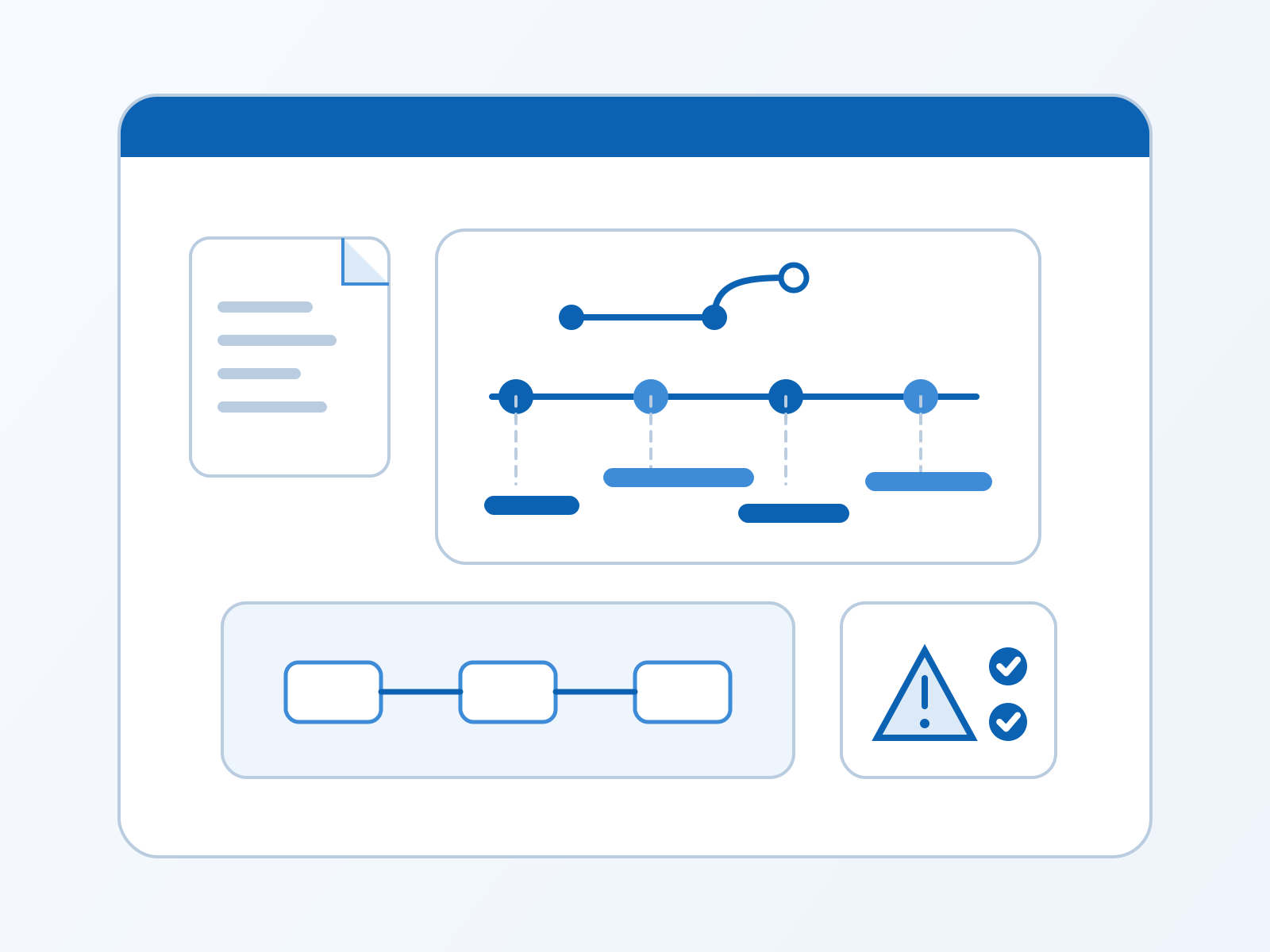
In disputed, delayed or poorly documented IT projects, the first task is to establish which technical and documented project state actually existed at a particular time. Requirements, tickets, specifications, repository history, builds, releases, tests, technical decisions, communications and change records can be correlated into a reviewable technical chronology. The objective is not retrospective project management, but a traceable technical reconstruction of findings, deviations, risks, alternative explanations and statement boundaries.
Typical questions
- What technical project state existed at a defined date?
- Which requirements, changes and acceptance criteria were documented and technically implemented?
- Which repository, commit, branch, build, release or deployment states can be reliably attributed?
- Which architecture or technology decisions are documented and what technical consequences are visible?
- Where do tickets, specifications, communications, code, tests and delivered system states contradict one another?
- Which technical risks, dependencies, open points or technical debt are supported by the evidence?
- Which alternative explanations remain plausible for delays, failures or quality problems?
- Which conclusions cannot be supported reliably by the available evidence?
Methodological approach
The examination separates question, examination period, reference requirements, technical artefacts, finding, interpretation and professional assessment. Timestamps, tickets, documents, repositories, commits, tags, builds, test evidence and deployment records are correlated into a reviewable chronology where the evidence supports the attribution. Deviations are tested against plausible counter-hypotheses and alternative causes rather than inferred from temporal correlation alone.
Further technical knowledge: The article Reconstructing IT project history: tickets, repository history, emails and records explains how technical and organisational sources can be correlated into a traceable project chronology.
Examination logic for project reconstruction
The iterative problem-solving cycle of diagnosis, objective definition, analysis and decision-making provides the overarching framework. In a project assessment it is applied to historical and technical evidence. New records may require the examination period, reference requirements, hypotheses or earlier interpretations to be revisited.
Keep multiple timelines separate
Project sources can carry different time references. Ticket time, author and committer dates, build time, release time, deployment time and the actually observed runtime state may differ. A supportable reconstruction records these levels separately and connects them only where technical or documentary evidence supports the attribution. Missing intermediate states or conflicting timestamps remain explicit uncertainties.
Assessment focus
- Requirements, specifications, acceptance criteria and requirements-to-actual-state comparison.
- Project chronology from tickets, records, communications and technical artefacts.
- Repository, commit, branch, tag, build, release and deployment history.
- Architecture, interfaces, data flows and integration decisions.
- Test, QA and acceptance evidence and its technical significance.
- Change requests, scope changes and their technical effects.
- Dependencies, technical debt, maintainability and operating risks.
- Handover capability, supplier change and technical transferability.
Extended technical examination modules
- Delivery state: Is only source code available, or also a reproducible build, test and deployment state?
- Decision history: Which technical decisions, assumptions and rejected alternatives are documented?
- Project handover: Are repositories, build processes, configuration, documentation and dependencies technically transferable?
- Project crisis: Which technical factors can explain failed releases, integration problems or recurring incidents?
- Provenance: Which origin and development traces of software artefacts can be reconstructed technically?
- Definition of Done: Which documented criteria existed and which evidence supports fulfilment or non-fulfilment?
Technical findings do not automatically answer contractual interpretation, breach, fault or damages. Those decisions remain with the responsible legal or commercial decision-makers.
Areas of application
Typical applications include technical project disputes, project cancellations, handovers and supplier changes, reconstruction of historical delivery states, technical classification of change requests and preparation of audits or technically informed decision processes. The examination scope is limited to technically reviewable questions and is expressly separated from legal, tax or commercial advice.
Example scope of an assessment
- Review of project records, specifications, change logs and communications.
- Technical assessment of implementation and architecture.
- Reconstruction of repository, build, test, release and deployment evidence.
- Report with findings, professional assessment, counter-hypotheses and statement boundaries.
Indicative fee guidance by scope:
- Clearly delimited technical review or expert statement: approximately €1,500–€4,500 net
- More extensive technical expert assessment: approximately €4,500–€10,000 net
- Complex IT expert report with extensive technical examination: approximately €10,000–€20,000 net or more
The actual effort depends in particular on the technical question, project and system size, number and condition of the artefacts to be examined, quality of the available records, required examination depth and report documentation.
After an initial review of the question and the available material, an individual non-binding proposal can be prepared. Depending on the subject matter, a fixed price or another suitable fee arrangement may be agreed.
The amounts above are intended solely as initial guidance and do not constitute a binding offer. The actual effort may fall outside these ranges in an individual matter.
Author's technical literature and publications
The following works provide additional technical and methodological context. They do not replace required primary sources, standards, manufacturer documentation or other independent specialist sources. Unpublished manuscripts, drafts and teaching materials are deliberately not presented here as public sources.
Further technical knowledge
Constructed case study: IT project assessment
Reconstructing project history, requirements and technical evidence before assessing deviations.
Constructed examination scenario: This is a methodological example, not a real mandate, a real court appointment or a report of actual findings.
Diagnosis – reconstruct the project situation
Review schedules, requirements, change records, communications, repository states and technical deliveries. Separate technical, organisational and communication factors.
Objectives – define the examination frame
Specify whether the assessment concerns requirements implementation, acceptance criteria, project chronology, technical decisions, delivery states or another defined technical question.
Analysis – correlate documentary and technical evidence
Compare specifications, tickets, repositories, builds, tests and releases. Test alternative explanations for delays, integration failures or quality issues instead of inferring causality from chronology alone.
Expert synthesis – documented deviations and limits
Summarise what is technically supported, which deviations are documented and which uncertainties remain. Contract interpretation, breach, fault and damages remain outside the technical assessment.
Methodological inspiration: Nicolai Andler, Tools für Projektmanagement, Workshops und Consulting – Kompendium der wichtigsten Techniken und Methoden, 6th revised and expanded edition, Publicis, Erlangen, 2015, ISBN 978-3-89578-453-8. The examination sequence and expert synthesis used here are independently formulated for technical expert work.
Initial technical classification of an enquiry
Before accepting an assignment, the technical question, subject of examination, available records, possible conflicts of interest and the required scope are reviewed. An individual non-binding proposal can then be prepared.
Contact Mathias EllmannFrequently Asked Questions about IT Project Assessments
What is an IT project assessment?
It reconstructs the technical and organisational course of an IT project in order to identify documented causes of delays, defects or conflicts.
When is an IT project assessment useful?
It can be useful after project delays, cancellation, disputes or quality problems when the project history needs to be reconstructed from evidence.
Which documents are typically relevant?
Requirements, project plans, code states, repositories, change records, test evidence, release records and relevant communications may be required.
How can the assessment be used?
It provides a technical evidence base for professional clarification and can prepare technical questions for out-of-court or court contexts.