Technical expert assessment of software quality
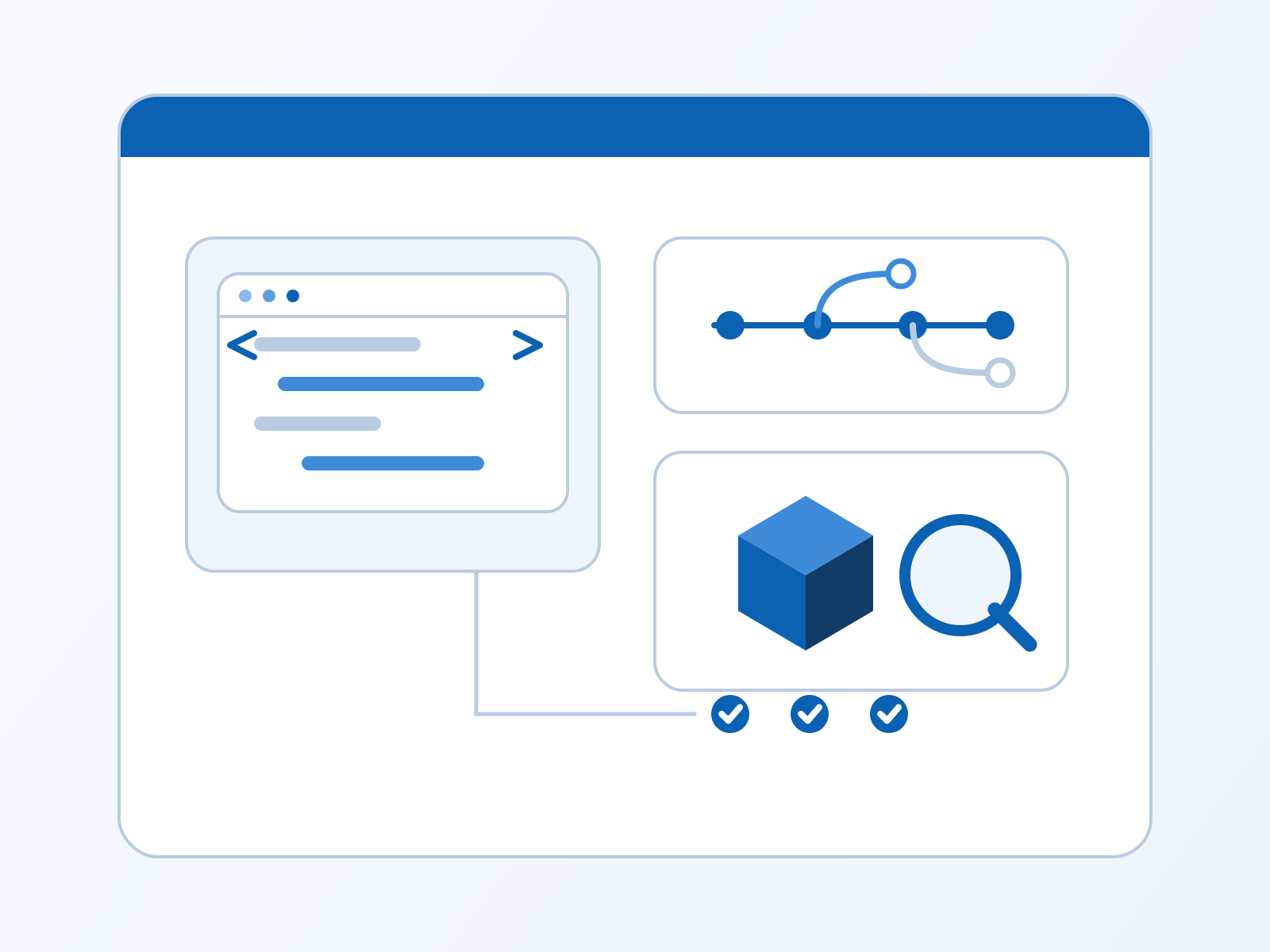
Software quality affects reliability, security, maintainability and the ability to reproduce a particular delivery state. A technical software assessment examines architecture, documentation, source-code quality, maintainability and technical risk against a defined code and system state.
Analysis and assessment areas
- Architecture and design: modularity, coupling, interfaces and scalability.
- Code quality and maintainability: readability, structure, testability and documentation.
- Software metrics and quality indicators such as complexity, test coverage and duplication.
- Technical debt and the risks associated with accumulated maintenance constraints.
- Version histories, build processes and continuous-integration evidence.
Methodological approach
Depending on the assignment, methods can include code review, static analysis, software metrics and structured architecture review. The report documents the examined repository, version and build context. A successful build or test only establishes the documented technical state under the examined conditions; it does not automatically establish contractual acceptance, legal permissibility or general suitability.
Examination logic: from the technical problem to a bounded expert conclusion
The iterative problem-solving cycle of diagnosis, objective definition, analysis and decision-making, as described by Nicolai Andler, provides the overarching framework. For technical software examination, that framework is made concrete through evidence and system-state analysis. The final synthesis is not equated with a legal, commercial or management decision.
Evidence chains rather than isolated indicators
A supportable technical attribution usually emerges from several connected records. A repository state can show that code existed, a build artefact can show that a concrete state was buildable, a runtime observation can show behaviour under defined conditions and a test record can show a result for the documented test environment. If those levels conflict, the conflict itself becomes part of the examination. Missing artefacts are stated as a limitation rather than replaced by assumptions.
Typical applications
- Disputes, quality problems or unresolved technical issues in software projects.
- Technical assessment for project acceptance, audit or quality assurance.
- Third-party code review in technical due-diligence contexts.
- Assessment of maintainability, extensibility and modernisation needs.
Objective and limits
The report provides technical facts, professional assessment and statement boundaries that responsible decision-makers can use in technical, commercial or legally influenced contexts. It does not replace a commercial decision or legal evaluation.
Example scope of an assessment
- Analysis of an agreed source-code base such as Java, C#, Python or JavaScript.
- Assessment of architecture, code quality, testability and documentation.
- Examination of interfaces, data structures and technical dependencies.
- Analysis of technical debt and maintainability risks.
- Report with findings, assessment, limitations and technically justified recommendations.
Indicative fee guidance by scope:
- Clearly delimited technical review or expert statement: approximately €1,500–€4,500 net
- More extensive technical expert assessment: approximately €4,500–€10,000 net
- Complex IT expert report with extensive technical examination: approximately €10,000–€20,000 net or more
The actual effort depends in particular on the technical question, project and system size, number and condition of the artefacts to be examined, quality of the available records, required examination depth and report documentation.
After an initial review of the question and the available material, an individual non-binding proposal can be prepared. Depending on the subject matter, a fixed price or another suitable fee arrangement may be agreed.
The amounts above are intended solely as initial guidance and do not constitute a binding offer. The actual effort may fall outside these ranges in an individual matter.
Author's technical literature and publications
The following works provide additional technical and methodological context. They do not replace required primary sources, standards, manufacturer documentation or other independent specialist sources. Unpublished manuscripts, drafts and teaching materials are deliberately not presented here as public sources.
Further technical knowledge
Constructed case study: software and source-code assessment
A structured examination sequence adapted from problem-solving phases described by Nicolai Andler.
Constructed examination scenario: This is a methodological example, not a real mandate, a real court appointment or a report of actual findings.
Diagnosis – establish the technical baseline
Identify the software architecture, relevant source-code state, build process and available documentation. Record weaknesses such as excessive coupling, insufficient tests or security-relevant dependencies as hypotheses to be examined rather than assumed conclusions.
Objectives – define technical criteria
Define review criteria such as readability, maintainability, changeability, testability and the applicable technical or project-specific standards before classifying the observed state.
Analysis – examine code and architecture
Use proportionate methods such as code review, static analysis, architecture review and technical metrics. Preserve the repository, version and build context to make the findings traceable.
Expert synthesis – findings, risks and options
Bring findings, counter-hypotheses, uncertainties and technical improvement options together. Recommendations are technical options; they do not replace management, contractual or legal decisions.
Methodological inspiration: Nicolai Andler, Tools für Projektmanagement, Workshops und Consulting – Kompendium der wichtigsten Techniken und Methoden, 6th revised and expanded edition, Publicis, Erlangen, 2015, ISBN 978-3-89578-453-8. The examination sequence and expert synthesis used here are independently formulated for technical expert work.
Initial technical classification of an enquiry
Before accepting an assignment, the technical question, subject of examination, available records, possible conflicts of interest and the required scope are reviewed. An individual non-binding proposal can then be prepared.
Contact Mathias EllmannFrequently Asked Questions about Software Assessments
What does a software and source-code assessment cover?
It can assess software architecture, source-code quality and documentation in order to establish the technical state of a defined software version.
When can a software assessment be useful?
It can support technical clarification in cases involving defects, disputes, quality assurance or an unclear software state.
Which methods can be used for source-code analysis?
Depending on the question, methods can include static analysis, architecture review, software metrics, code review and reproducible build or test evidence.
How can the report be used?
It documents technical findings and can support professional clarification. Its legal relevance in a specific proceeding is a separate legal question.